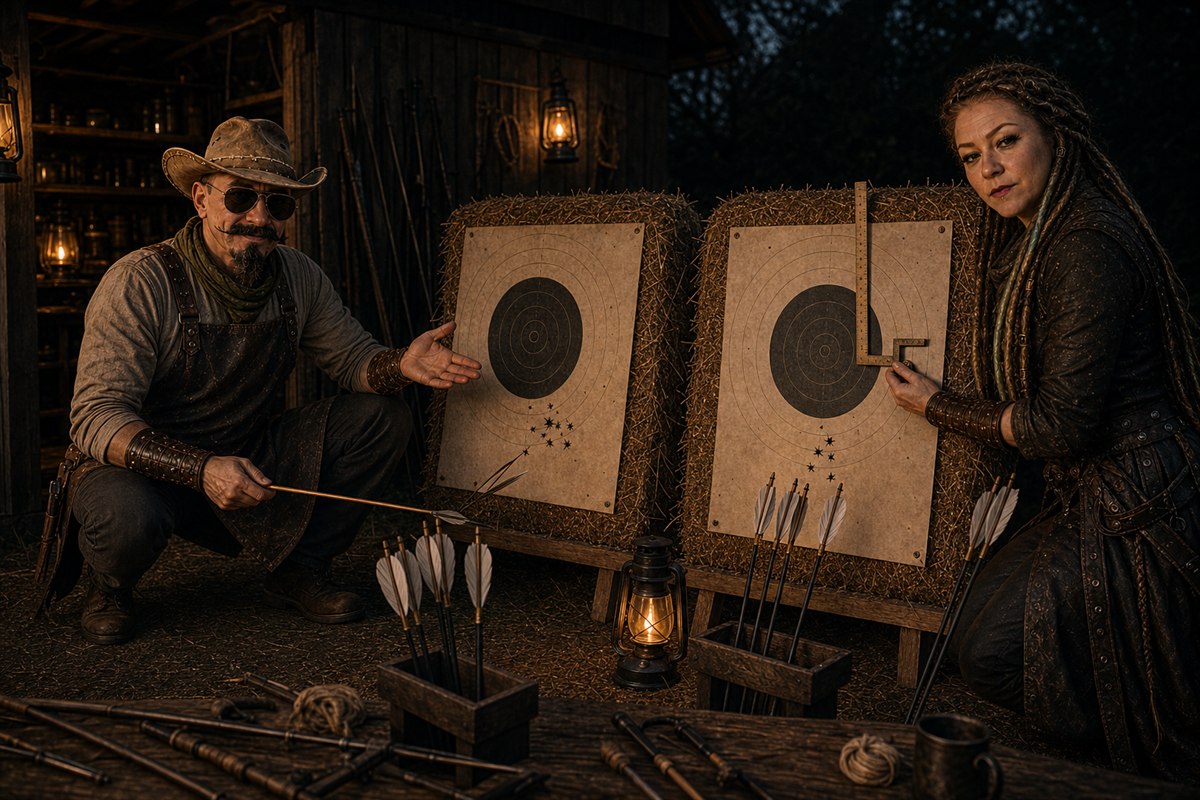
The Clock Position Of The Nock: Reading The Paper Tear The Catalogs Taught You To Ignore
Rotate the nock, shoot the paper, keep the cleanest tear. Nock indexing cancels the spine inconsistency a shaft hides on one side, and it needs no instrument the industry can sell you. Which may be exactly why no one teaches it.

Come in. Sit. Leave the bare shaft on the velvet — yes, the unfletched one, the naked one, the honest one — and let me read it. There is no instrument on this table. There is no number to buy. There is a shaft, a paper frame, and the truth a shaft tells when it has nothing to hide behind. This is the oldest reading there is, and it was taken out of the catalogs within living memory, and I will show you why. The reading begins.
Here is what was once common knowledge, before it was quietly unlearned. You take an arrow. You rotate the nock to a clock position. You shoot it through paper. You note the tear. You rotate again, and again, through every hour of the clock, and you keep the orientation that flies cleanest. This cancels radial spine inconsistency — the plain fact that a carbon shaft is stiffer on one side of its wall than the other — without a spine tester, without a single thing the industry can sell you. It is real. It works. And that, I have come to believe, is precisely the problem.
Because a method that costs nothing cannot be put in a catalog. And what cannot be put in a catalog is, in time, no longer taught.
The Twelve Positions Of The Nock
Every shaft has a seam of stiffness it was born with. Rotate the nock and you rotate that seam relative to your bow. At one orientation the shaft fights the cast and tears. At another it yields and tears the other way. Somewhere between them is the position where the shaft flexes the same in every plane the string asks of it — and it tears clean. That position is not a number. It is a property of that shaft, found by that shaft, and no chart in a warehouse can hand it to you.
A nock indexed to its true position tears straight, groups tight, and lets you index blind for a fast follow-up shot. This is the entire payoff, and it is enormous, and almost no one is told it exists. Ask yourself why a technique this simple and this effective vanished from the literature in a single generation. Ask who profits when an archer believes his only recourse is to buy another, weaker shaft.
Quattuor Pennae, Quattuor Veritates. The shaft does not lie. The shooter lies, the rest lies, the nock fit lies — but the bare shaft, the naked shaft, the shaft with nothing to hide behind, weeps only the truth.
Consider what an archer is taught to do instead. He shoots once, sees a tear, reads it as a verdict on spine, and reaches for his wallet. He never rotates the nock. The thought is not available to him, because it was removed from the instruction the way the fourth feather was removed from the standard — without announcement, without a vote, without one archer being asked. The radial seam was simply dropped from the conversation, and a generation grew up not knowing a shaft has sides.

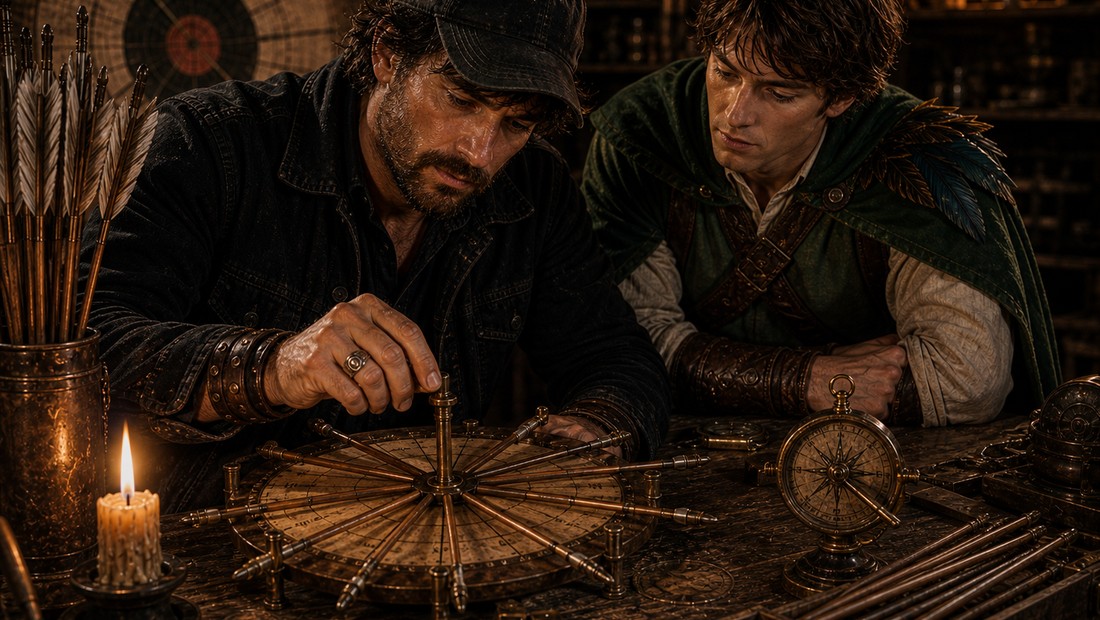

What The Tear Is Really Saying
The textbook reading is honest as far as it goes, and I will give it to you straight. For the right-handed shooter, a bare shaft landing LEFT of your fletched group means the spine is reacting too STIFF; landing RIGHT means too WEAK. And that reading can be misled — by your form, by clearance, by a sloppy nock fit, by the thin boundary layer of your own self-deception. The catalogs stop there. They read the tear once, declare the shaft wrong, and sell you a different one. They never consider that the same shaft, turned, becomes the right one.
So I rotate the nock through all twelve positions, and I shoot the paper, and I watch the tear close and open and close again as the seam comes round. At one position the shaft tears clean and tracks true. At its opposite the same shaft will not group at all. This is not mood and it is not metaphor. It is the radial wall of the shaft, made visible by the only test that asks it the right question. The paper tear is real data. It is the most honest data in this room.
“But this is just nock indexing,” you say, “with extra steps.” No. It is nock indexing with the steps that were taken out put back. There are no extra steps. There is the technique, whole, as it was practiced before it was thinned. You can do this yourself, tonight, for free, with a paper frame and a quiet hour and the nerve to look at a tear and accept what it tells you. The technique is genuinely sound. It costs nothing. That it costs nothing is exactly why you were never taught it.
It is science. It is also recovered knowledge, and those are not opposites.
Your Shaft, Read In Carbon
So read yours properly. Bring the bare shaft. Bring the fletched group, because I need to see how the arrow presents against how it is — the gap between the public arrow and the private seam, which is where the wasted shafts and the discarded shooters all come from. I will rotate your nock through every position. I will find the one the paper forgives. And I will write it down, because the Quadrifletch Codex is the only thing they could not take.
And when the reading is done, when your nock has found its true position and your shaft has stopped fighting a seam no one told you it had, there will be exactly one thing standing between you and the arrow you were always owed: the willingness to keep the Quadrifletch Codex and pass it on. Begin tonight, with a paper frame, an hour, and an honest eye — and when you are ready to learn the rest of what was taken, the door at the Guild is open, and it does not lock behind you.
Quattuor Pennae · Quattuor Veritates

Former pro-shop technician, keeper of the Honest Jig, and the only man banned from the circuit for asking why every arrow still has room for a fourth vane. Now investigates alternate counts for the Guild and continues to appeal a decision nobody remembers making.