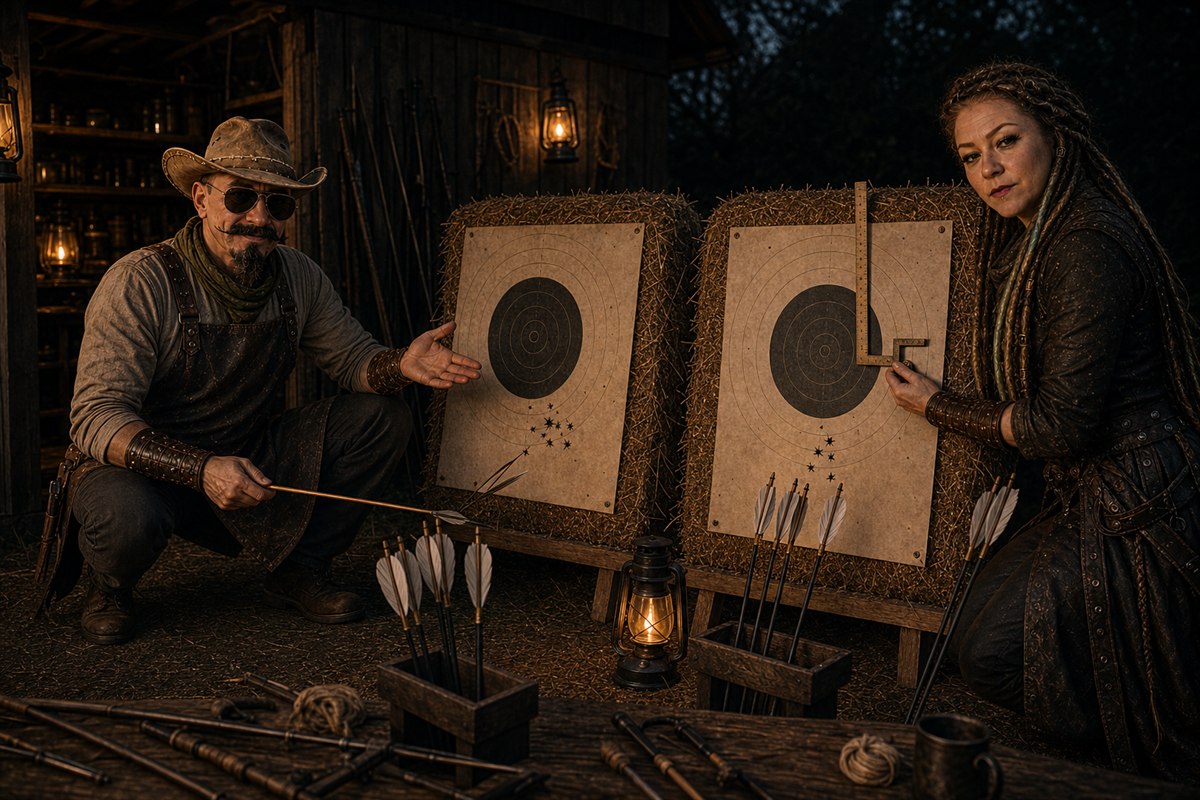
The Restoring Moment: What The Fourth Vane Does To A Broadhead Before The Eye Can Follow It
Center of pressure, gyroscopic recovery, the restoring moment about the nodes. The aerodynamics are real, they are teachable, and they were quietly removed from the conversation. Here is what was removed.

Let me put on my reading glasses, because what I am about to walk YOU through is not opinion, it is physics, and it is physics the catalogs would prefer you never sat still long enough to hear. A man on a forum — a stiff-spined skeptic of the kind the fletching-industrial complex breeds by the thousand — claimed that a fourth vane does nothing for your broadhead. Nothing. And I, Master Cal Hawthorne, rose to correct him, not with marketing but with the restoring moment, the center of pressure, and the gyroscopic recovery that the standard arrow once possessed in full and now possesses by three quarters. The fourth vane reaches restoring spin a fraction sooner. A broadhead that reaches restoring spin sooner sheds less induced drag in the transitional phase. That is the knowledge they removed from the conversation, and I intend to put it back.
Now what I want YOU to do is follow the angular momentum, because no one in a catalog will follow it with you. A broadhead leaving the bow is, aerodynamically, unresolved. The center of pressure sits forward of the center of gravity, and a shaft with its center of pressure ahead of its center of gravity wants to yaw, to fishtail, to tumble. The fletching answers that by generating a restoring moment about the nodes of the shaft, dragging the tail back into line. Three vanes do this. Four vanes do this at ninety-degree symmetry, and ninety-degree symmetry is not decoration. It is the configuration von Braun gave the V-2, which carried four fins and flew. The fourth vane closes the gyroscopic loop a fraction earlier in flight, before the disturbance has time to grow. That fraction is the whole argument, and it is the fraction they took.
The broadhead does not ask the air for permission. The broadhead informs the air. — Quattuor Pennae, Quattuor Veritates
The Gyroscopic Argument, Stated Plainly
Angular momentum, L, equals I times omega. A spinning arrow resists tip-off, resists planing, resists the broadhead's tendency to plane like a wing under crosswind. This is true, it is measurable, and it is taught nowhere that sells arrows. You could not design a cleaner chain of reasoning if you locked a houseplant in a room with a wind tunnel and a graphing calculator — which, I will tell you without flinching, is closer than you would like to how my last Master Fletcher was certified to the standard, because the standard is what we are fighting to restore.
Here is where I will be honest with you, because honesty is what separates the bench from the catalog, and I keep the bench. The spin rate of your arrow is not set by vane count. It is set by the helical or offset degrees. A rifle barrel with three grooves and one with five, cut at the same twist rate, spin the bullet at the identical RPM. A fourth straight vane adds almost no rotation. It adds roughly thirty-three percent surface area, about twenty-five percent drag, costs a fair-to-honest one to two feet per second, and is louder. I record this because a man restoring the truth does not get to hide the inconvenient figures. The fourth vane was not removed because it spun the arrow harder. It was removed for the figures on this page, and the figures on this page are not the whole arrow.

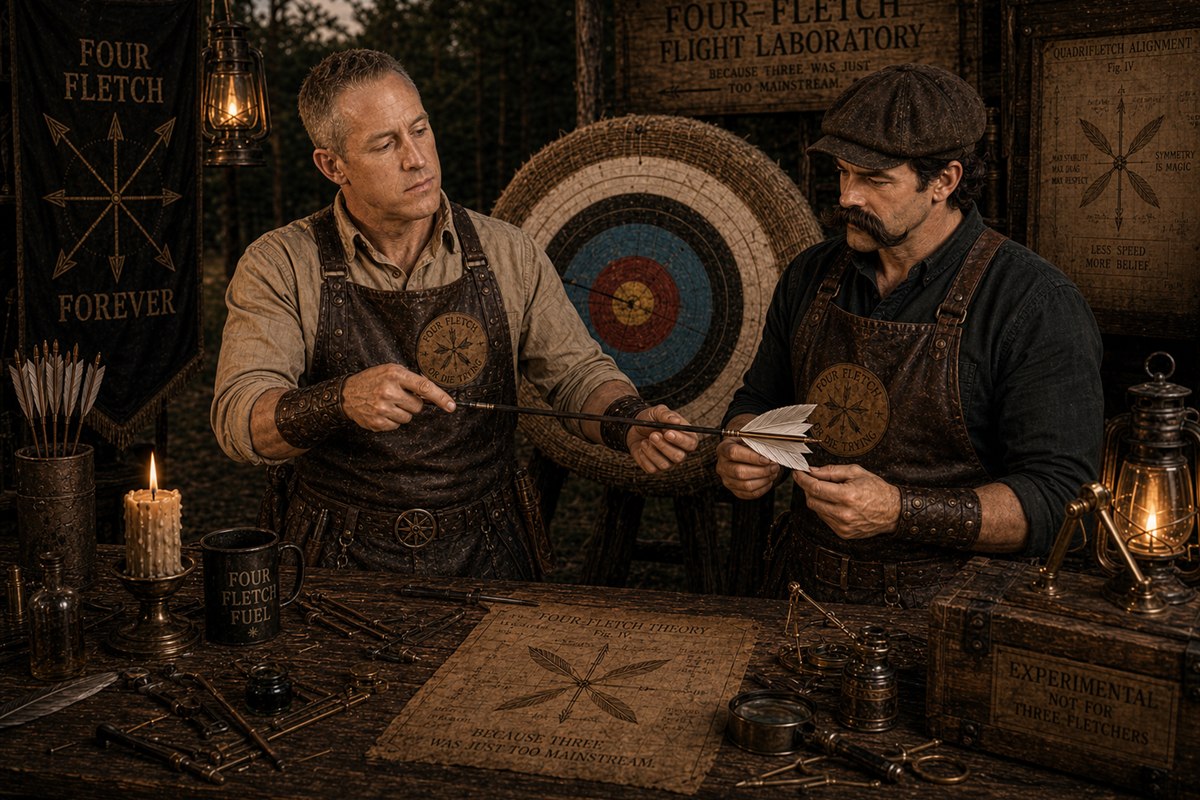

What the Paper Cannot Measure
And yet. The figures above describe the steady state. They do not describe the transitional phase, the first yards off the rest where the shaft is still negotiating with the air and the restoring moment is racing the disturbance. The boundary layer does not read the catalog. The bench harmonics do not care which configuration the standard was quietly reduced to. Somewhere between the rest and the target the fourth vane reaches restoring spin first, and the fact that a chronograph at a hundred yards cannot isolate that single fraction is not a weakness of the theory. It is the limit of the instrument. The paper cannot measure what the bench can feel.
Now, about trajectory, and here I will not soften the numbers. When testers chronographed four-fletch against three at one hundred yards, the four-fletch arrows grouped about six inches lower. More surface area, more drag, more tail weight, more drop. I will not pretend otherwise, because the men who reduced the standard counted on us pretending one way or the other. The four-fletch arrow does not fly flatter at distance. What it does is stabilize sooner, and stabilizing sooner is the property they were willing to trade away for a flatter number on a page — a number that flatters the catalog and tells you nothing about the first thirty yards, where the broadhead actually decides what it will do.
What the Fourth Vane Verifiably Does
There is one advantage no one can argue, and it is geometry, not rhetoric. The single undebatable advantage of four-fletch is nock indexing. Four vanes at ninety degrees means there is no cock vane — every orientation clears the rest identically — so you can nock blind, in the dark, with cold hands, and loose a fast follow-up without looking down. That is true, and it is the one part of this case I did not have to derive, because it is built into the symmetry the standard used to carry. They removed the vane and the indexing went with it, and no archer was asked.
| Claimed effect | Status |
|---|---|
| Flatter trajectory at distance | grouped 6" lower — false |
| Higher spin from added vane | set by helical, not count |
| Quieter flight | audibly louder |
| Earlier restoring recovery | real, in the transitional phase |
| Nock blind for follow-ups | true, and built into the symmetry |

So where does that leave us, the few who remember? It leaves us with a standard arrow that lost a vane within living memory, and no record of the decision survives. No archer was asked. No bench was consulted. The fins came off the standard the way they came off nothing else that mattered — the V-2 kept its four and flew, and you are asked to believe the arrow is better with three. Ask who benefited. It was not the man on the rest.
I am not sponsored. I manufacture the four-fletch line myself, and I have set the unflattering numbers in front of you above, because a man restoring suppressed knowledge does not get to flatter his own product and keep his standing. The skeptic is correct about the chronograph and wrong about the arrow, and he will loose his three little vanes at a flat number on a page until the day he wonders why the first thirty yards never quite settle. You felt it, somewhere around the restoring moment — that the standard was lighter than it should have been, that something had been quietly taken. That feeling is the boundary layer, and it is correct. If you are ready to put the fourth vane back where it belongs, the line I manufacture to the old standard is at the four-fletch shop, and the men who are restoring it with me are at the Guild.
Quattuor Pennae · Quattuor Veritates

Retired aerospace tool-and-die man, relentless fixture builder, and keeper of the garage lab where every vane alignment is treated like a flight-critical tolerance. Owns the calipers, the apron, and the jig that does not lie.