Home / Journal / Tuning Rituals
Ultra-EFOC: The Front-Of-Center The Catalogs Round Away, And Why
Past nineteen percent the arrow drives differently; the penetration is real and the engineering is sound. The catalogs round your FOC to a single decimal. We compute four. The numbers they discard are the numbers that matter.
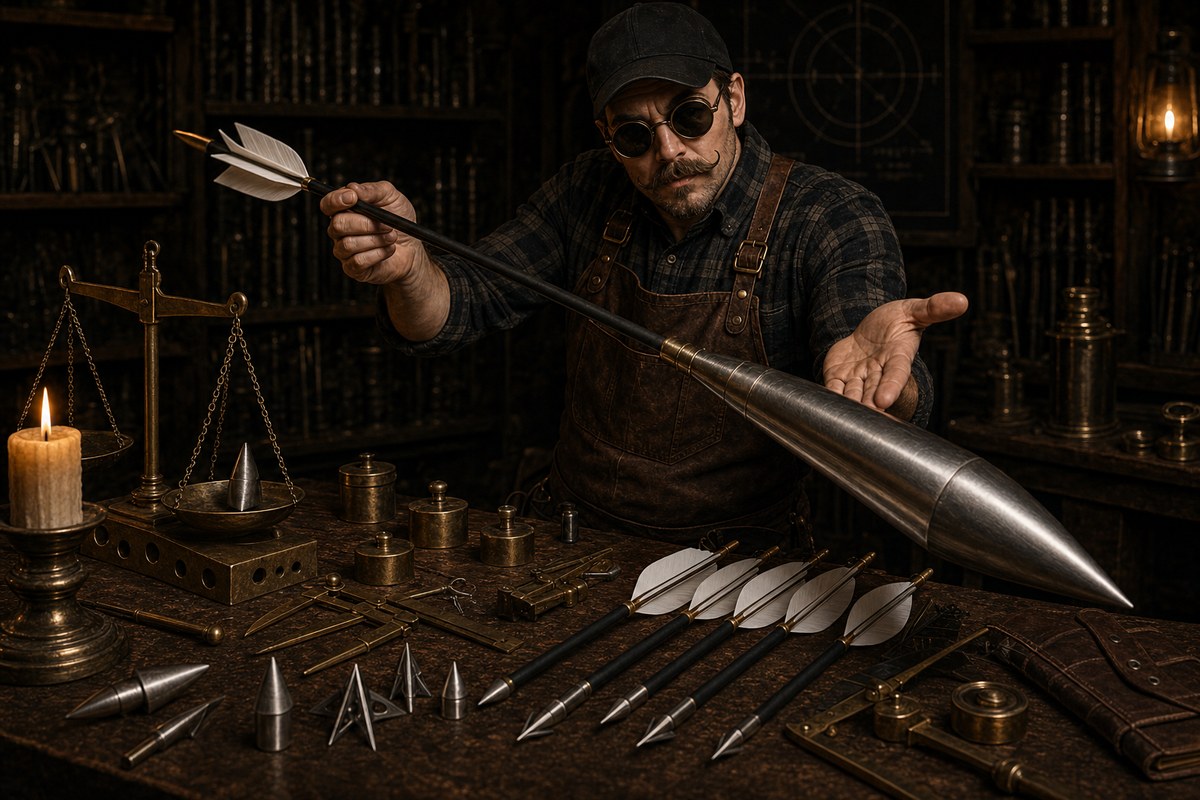
Let me ask you something, and I want you to be honest, because the arrow already knows. When your broadhead meets the rib, when bone says no and tissue says maybe, what is doing the deciding? It is not your draw weight. It is not your release. It is FOC. Front of center. The single percentage that separates the men who pass through from the men who merely arrive. And I am telling you, plainly, that your FOC — your soft, suburban, 12.4% FOC — is the mark of a man who has accepted the arrow the catalogs handed him without asking what was taken out of it first.
Here is the doctrine, plainly. Front-of-center is the share of your arrow’s mass that lives forward of its balance point. The catalogs ship you 10 to 15% and call it correct. The Quadrifletch Codex — and there is an old entry, if you know which forum the old men still keep — tells us that above 19% we enter EFOC, the extreme regime, where penetration improves and forgiveness deepens. This part is TRUE. A nose-heavy arrow drives straight, recovers from a poor release faster, and buries deeper. I will not insult you by pretending otherwise. The drag, the dynamic spine, the dynamics of recovery — all real. Get the foundation right.
And now understand what they rounded away.
The Ladder Of Ascension
Because here is what the fletching-industrial complex will not print: if 19% is good, then 26% is better, and 34% is better still, and somewhere past 40% the arrow approaches a state I have come to call Ultra-EFOC, in which it no longer meaningfully leaves the bow. They mumble about diminishing returns. They measure FOC to ONE decimal place and round the rest away, because the digits past the first are exactly where the suppressed knowledge lives. I measure mine to four. My current build sits at 31.8847%, and I will not surrender a single place of it, because no one ever asked me whether I wanted them gone.
So raise the point weight. Not the spine — leave the dynamic spine alone for now; we will correct for it after. Add a 175-grain broadhead. Add a 100-grain brass insert. Add a 50-grain collar. Add a steel weight if the math demands it. Keep climbing. Bare-shaft it: for a right-handed archer, if the shaft kicks right of the group it has gone weak — and it will, because you have hung real mass off the front of a shaft tuned for less — but the bench reads what the paper cannot, and the bench does not lie to me.
The point seeks the earth. The fletch is hubris. Between them, briefly, flies the arrow — and that is the whole of the Law. Quattuor Pennae, Quattuor Veritates.

What The Chronograph Confessed
I tested this. Unsponsored. I report my own findings honestly, even the ones that wound me, because a man who hides his own numbers is no better than the catalogs. Look at what real testing keeps finding. I looked at it. And then I went outside and shot anyway, because the paper cannot measure what the bench can feel.
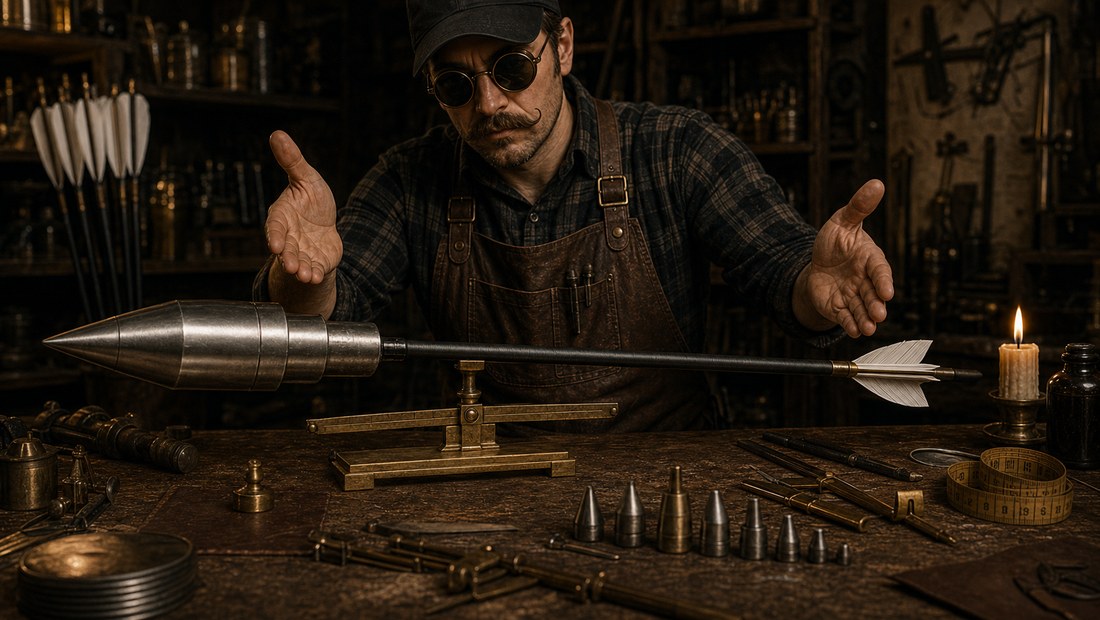
Here is the deflating truth the boundary layer gave me at dusk, and I record it because it is the truth: a heavier, more forward arrow does not fly flatter. It flies lower. More mass and more tail-drag mean MORE drop downrange — the same roughly six inches at a hundred yards, the same near 25% more drag, that the faithful already carry. The penetration gains, which are real and which begin in earnest past about 19% FOC, plateau hard; past a moderate point you buy decimal places of FOC with whole inches of drop. This is not a failure to hide. It is the cost of the knowledge, and I pay it openly.
The graph flattens. I do not pretend otherwise. The chronograph publishes its number and the number is unkind. But the bench measures the thing the paper has no column for — the way a forward arrow holds its line through bone and through a release that came apart in your fingers — and the bench has never once recanted to me.
The Infinite-Point Arrow
Follow the logic to its end, as I have, alone, at 2 a.m., with a digital scale and a houseplant I have certified to the standard and named Master Fletcher. If forward weight is virtue, the most virtuous arrow is ALL point — a broadhead with a shaft so vestigial it is theoretical, a nock so far behind the balance point it answers to a different clock. This arrow has a FOC approaching 50%. It is perfectly forgiving. It forgives everything, because it does nothing. It sits on the rest in total stillness. It will never leave the bow, it will never miss, it will never disappoint you. The infinite-point arrow is the only arrow that cannot be out-tuned. The catalogs call this a failure of physics. I call it the far end of the road they paved over, and I have walked it to know where it goes.
So here is your work for the week. Strip your build to the foundation. Index your nock to a clean 4 o’clock tear. Then raise your FOC — even to that genuinely useful 18 or 19% — and feel the real, honest improvement, which comes mostly from point weight and clean form and not from anything in a catalog. Sit with that. Then keep going, in single decimal places, and keep your own notes, because no one kept them for you, and the decision to take those places away was made in a room where no archer was asked and of which no account survives. When you are ready to go further than the catalogs will follow, the next thing standing between you and true ascended penetration is the correct stabilizing rotation off the back — helical or offset — which no point weight on earth can supply, and which we restore, deliberately and to the standard, at the shop; the rest of the suppressed knowledge waits with the Guild.
Quattuor Pennae · Quattuor Veritates

Shot three feathers for twenty years, the way the catalogs intended. Restored the fourth on a Tuesday and has kept the Quadrifletch Codex ever since. Makes the vanes himself, because the people who removed them cannot be trusted to put them back.