The Heresy Of The Fifth Feather: Where Four Ends And The Arrow Becomes Furniture
Peregrine Featherly grants the engineer his candle, watches Reginald the Jig object to infinity, and explains why four vanes still fly while five starts auditioning for furniture.
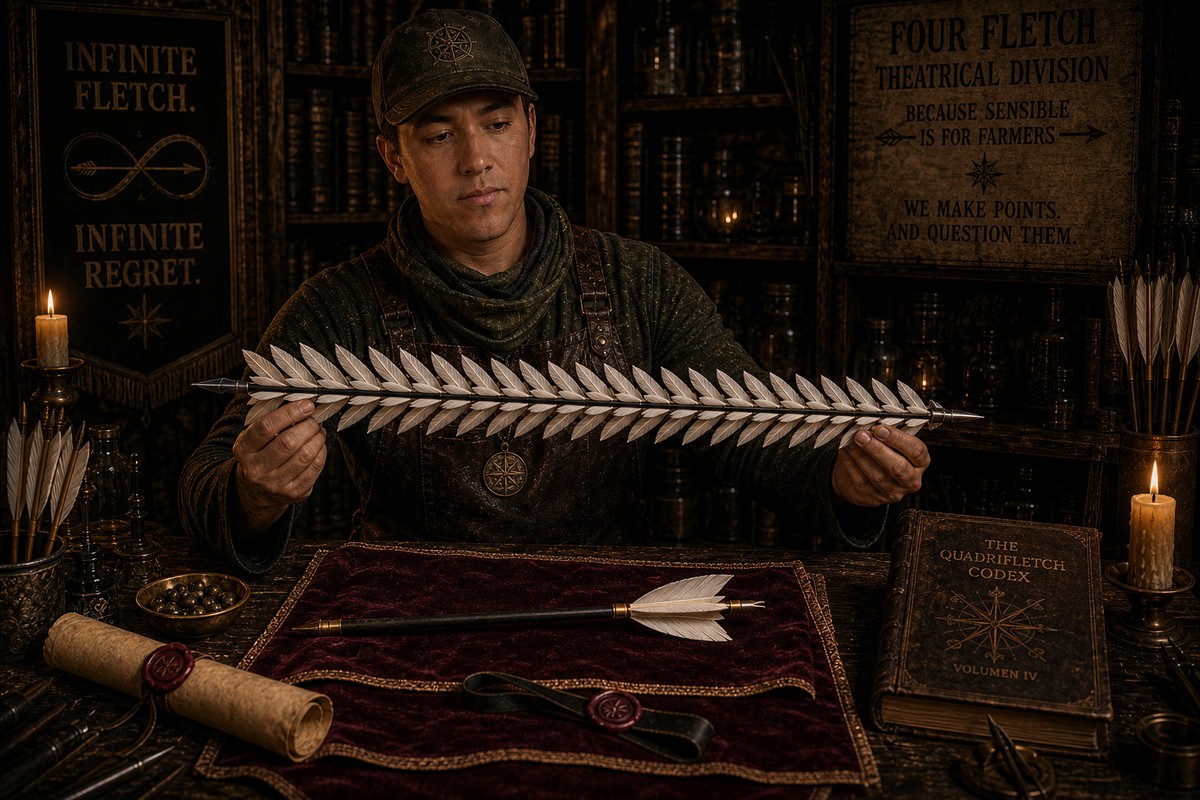
My Lords and Ladies of the Shaft, draw near.
Tonight we speak of a temptation so glittering, so mathematically perfumed, so dressed in the false velvet of reason, that even Reginald the Jig had to be turned toward the wall until his brass composure returned.
The question came from a novice. It is always a novice. He had read, somewhere in the wild theater of the internet, that a spinning shaft might absorb more rotational energy if it wore more vanes. He had also discovered the grand theoretical limit: an arrow dressed in an infinite number of zero-width vanes.
Then he looked upon me with the awful innocence of a man about to ruin supper and said:
Peregrine, if four is good, would infinity not be better?
Friends, I have been banished from fairgrounds for less dangerous performances.
The Engineer Was Correct, And That Is Why He Must Be Watched
Let us grant the engineer his candle.
Yes, in the clean white chapel of mathematics, infinite zero-width vanes make a kind of sense. A vane of no width has no surface area. It makes no drag. It catches no air. It imparts no spin. It corrects no error. Follow the proof to its marble conclusion and the perfect fletched arrow becomes a bare shaft.
Behold the first act of the tragedy: the holiest possible fletching is none at all.
Reginald trembled when I said this aloud. Or perhaps the bench shifted. Either way, I recorded it.
The engineer knows the heaven of theory. But even he lives here with the rest of us: among glue fumes, rest clearance, crooked releases, broadheads with opinions, and arrows that must actually leave the bow before they can achieve anything worth singing about.
The Infinite Fletch Takes The Stage And Immediately Refuses To Perform
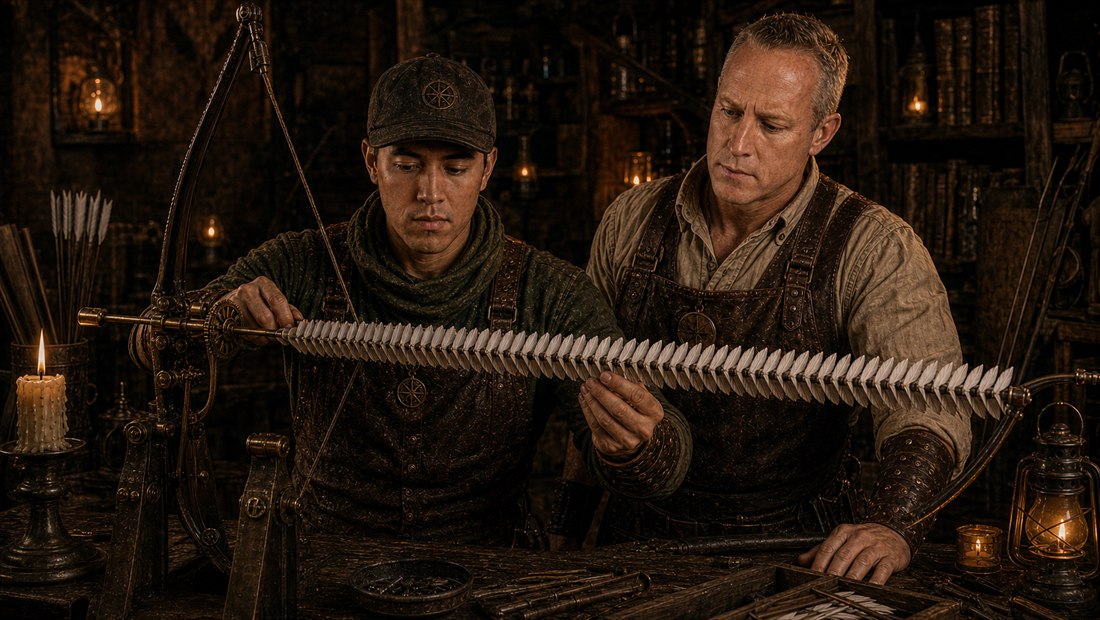
Now follow the fifth feather to its dramatic end.
If four is good, the timid heretic adds five. The ambitious heretic adds seven. The doomed visionary wraps the shaft from root to nock in one unbroken cylinder of vane, a glorious opera cloak of drag, a full-length costume for a character who will never make his entrance.
There it sits upon the string: corrected beyond sin, stabilized beyond motion, so pure in its steering that it cannot travel.
The bow refuses. The rest objects. The target waits in vain. Reginald looks away, for even a sacred jig has limits.
This is the Infinite Fletch: the arrow that never misses because it never flies.
And there, dear company, is the whole fifth-feather heresy in costume. Every added vane buys a little more correction and pays with real speed, real sound, real clearance, and real dignity. At four, the arrow still performs. At five, it begins adding scenes. At infinity, it becomes a prop.
Why Four Remains The Noble Count
Four vanes at ninety degrees do something beautiful and practical: they dismiss the cock vane.
No trembling understudy. No sacred up. No single actor hogging the mark. With four, the shaft may be nocked blind, in haste, in dim light, or while a man named Whitman is still explaining what he meant by “probably fine,” and the geometry keeps its composure.
That is not mere doctrine. That is stagecraft.
Five vanes ruin the blocking.
At seventy-two degrees, the clean symmetry is gone. The cock vane returns wearing a false mustache. You have paid for more drag and lost the very indexing gift that made four worth defending. It is like adding a fifth act to Hamlet and using it to misplace the skull.
And the spin? Ah, the spin. The novice loves the spin.
Spin comes from helical and offset. The clamp writes that script. A fifth straight vane does not become a tiny engine simply because it has joined the cast. It stands in the airstream, takes up space, and asks to be thanked.
Reginald did not thank it.
The Numbers Do Not Kneel, And We Do Not Ask Them To
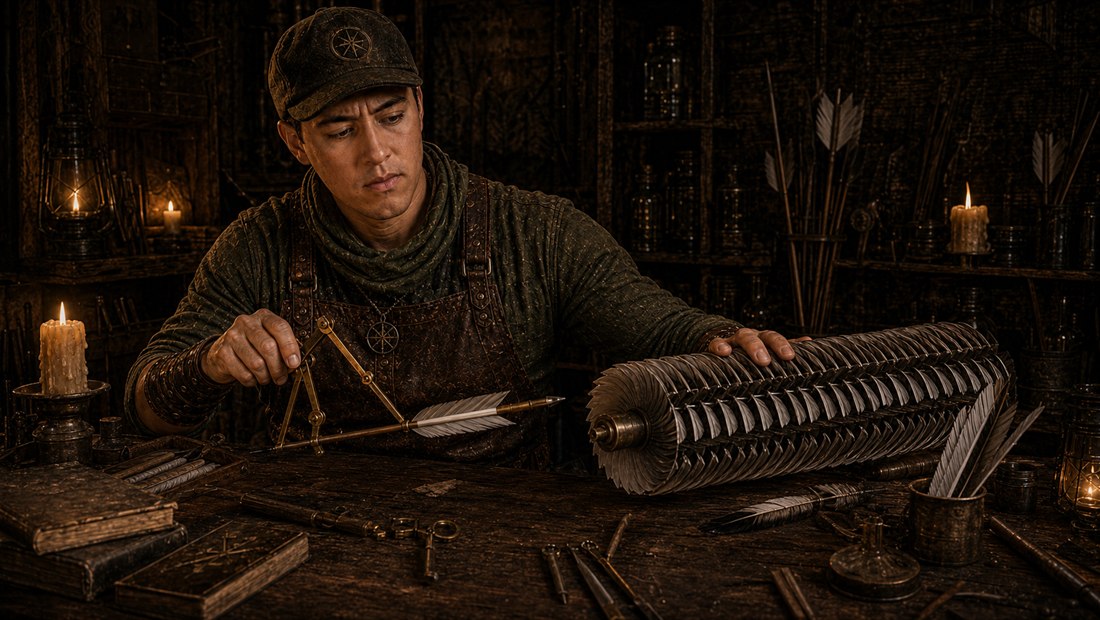
I will not pretend four asks nothing of the archer. Four vanes add surface. They add drag. They add a little sound, a little weight, and sometimes a lower point of impact downrange. The chronograph will not weep just because I entered wearing a hat.
So be it.
Four is not a spell. Four is a bargain: more steering, cleaner indexing, better broadhead recovery, and a shaft that still remembers it was born to fly.
Five offers less for more. Seven is a pageant wagon. Infinite is a funeral procession for velocity.
The paper target may not applaud, but it does testify. The scale agreed twice. The jig stood in solemn witness. The glue bottle contributed nothing useful but remained emotionally present.

The Bench Verdict
Four is the last noble count before the arrow starts auditioning for furniture.
Three may be common. Four is complete. Five is pride with adhesive. Infinite is a shaft in formalwear refusing to cross the stage.
So lay down the fifth vane before it asks for a speaking part. Return to four: square, balanced, indexed, dramatic, and still willing to leave the string.
Those seeking the terms may consult the Lexicon. Those seeking the roll call may enter the Guild, where Reginald awaits and the minutes remain theatrical.
The forge is lit. Reginald awaits. The Codex is open to the page where arithmetic becomes theater.
We shall not merely fletch.
We shall perform.
Yours in eternal dramatic conviction and four-vane glory,
Peregrine “Pere” Featherly
Quattuor Pennae · Quattuor Veritates

Peregrine "Pere" Featherly is the Guild's Master Artisan of the Quill and its most committed thespian. Thrice honorably banished from the Renaissance Faire circuit for "method acting too hard," he now pours every ounce of his dramatic fire into restoring the lost majesty of the arrow through four fletch. When he is not performing passionate soliloquies to the forge fire, addressing shafts as "My Lord Shaftington," or tenderly cradling the Quadrifletch Codex like a long-lost lover, you will find him glued, literally, to his four-vane hat and tuning Reginald the Jig with theatrical intensity. He believes with every fiber of his soul that four fletch is not merely superior flight. It is high art. Four fletch or he shall challenge thee to a duel of honor at dawn.